|
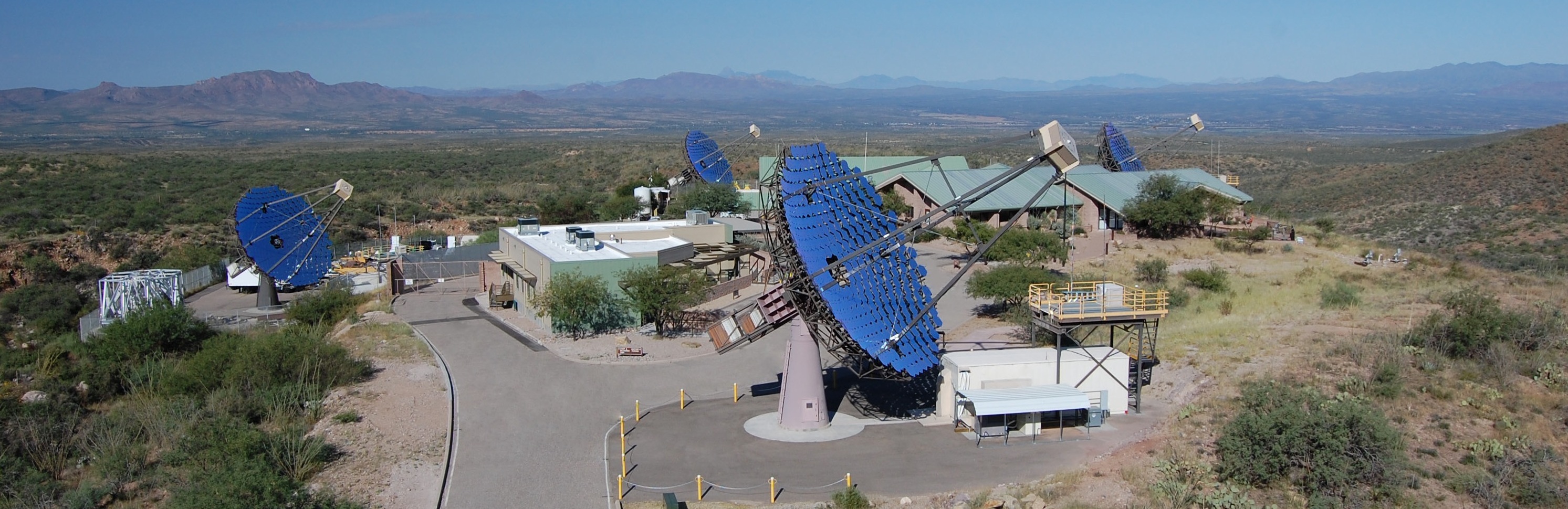
VERITAS (Very Energetic Radiation Imaging Telescope Array System) is a new major ground-based gamma-ray observatory with an array of four 12m optical reflectors for gamma-ray astronomy in the GeV - TeV energy range . The telescope design is based on the design of the existing 10m gamma-ray telescope of the Whipple Observatory. It consists of an array of imaging telescopes deployed such that they permit the maximum versatility and give the highest sensitivity in the 50 GeV - 50 TeV band (with maximum sensitivity from 100 GeV to 10 TeV). This VHE observatory will effectively complement Fermi.
Image of one of the VERITAS telescopes with the Moon, Jupiter and Venus in alignment overhead (photo by P. Fortin). New! Make sure you check out our Recent Results section (last updated June 23)! New! VERITAS Highlights January 2009! |
|
Read more...
|
|
|
Postdoctoral Position at Purdue |
|
Applications are invited for a postdoctoral position in high energy astrophysics in the Department of Physics at Purdue University. The successful applicant will work with the VERITAS group to pursue VERITAS-related science. VERITAS is an array of ground based gamma-ray telescopes currently operating in southern Arizona. The group is mainly interested in pulsars, pulsar wind nebulae/supernova remnants, microquasars, and active galactic nuclei. The successful applicant will also be strongly encouraged to pursue his/her own scientific interests and to collaborate with other members of the high energy astrophysics group. |
|
Read more...
|
|
|
Information for Mountain Users |
|
VERITAS operates during all moonless time troughout the year except during the monsoons (approx. July - August). In addition to these dark-times, VERITAS is now operating under partial moonlight which includes all nights except those immediately before and after the full moon. If you are visiting the Whipple observatory at night, please assume that VERITAS is operating and take the appropriate precautions. - If you need to drive into the Whipple observatory at night, please contact the observers via the radio or phone (1-480-626-2343) to arrange a window where you can arrive and leave. VERITAS operates on a 20 minute cycle and you can cause the least interference if you plan to arrive at the end of one of these cycles.
- Please observe the general observatory rule of using parking lights only.
- If you have any questions, don't hesitate to contact us.
|
|
Read more...
|
|
|
Postdoctoral Postition at Utah |
|
Applications are invited for a postdoctoral research assistantship at the Department of Physics and Astronomy of the University of Utah. The successful applicant will work with Prof. David Kieda and Prof. Stephan LeBohec on the analysis and interpretation of observations from the VERITAS high-energy gamma ray observatory, as well as on the conception of the next generation experiments. A PhD in astronomy or physics is required, and related experience is highly desirable. Experience in X-ray, soft gamma ray astronomy, and/or observational astronomy would be a plus. The position is for two years starting in 2008, and offers competitive salary and benefits. There is potential for the individual to teach at the University of Utah, if desired. |
|
Read more...
|
|
|
This image is from TeVCat , an online, interactive catalog for very-high-energy (VHE; E > 50 GeV) gamma-ray astronomy developed by our very own Deirdre Horan and Scott Wakely. As VHE astronomy continues to grow, the usefulness of a one-stop clearing house for information on new sources is increasingly evident. TeVCat is intended to be such a resource. With sky maps, scientific information, visibility plotters and linked references, it will help the wider gamma-ray community stay up-to-date and informed on this exciting and rapidly developing field. You can find TeVCat at http://tevcat.uchicago.edu . |
|
|
Multiwavelength Information |
|
VERITAS Multiwavelength Campaign Information on the VERITAS multiwavelength campaign can be found at http://jelley.wustl.edu/multiwave. This site includes details on the current campaigns as well as the ability to sign-up for email alerts. Whipple 10m: Currently Monitoring AGN 2007-2008 Campaign Has Begun: The Whipple 10m telescope is monitoring a short list of AGN including 1ES2344, 1ES1959, Markarian 421, H1426 and Markarian 501 from Sep. 2007 - Jun. 2008. Click here for the latest information. |
|
|